1. Motivation
Concentration of Power corrupts every political system.
Socialism hates monopolies but introduces strong government.
Capitalism hates government but introduces strong monopolies.Power consolidation is the core phenomenon at the root of unfairness, economic inequality, every societal issue, every political system, and more generally: human suffering.
Read more: Appendix A.1: Vicious Cycle
It happens as a side effect of large scale organization using hierarchies.
The only time we delegate power is when we need to organize.
No human should govern. Software offers the best alternative.
Since all human beings are corruptible by power, only mathematical rules are objective enough to be trusted to facilitate our self-coordination.
This implies that a solution for the vicious cycle may be found in democratically-driven (open source) software.
Read more: Appendix A.4: Who can we trust
Free Market Capitalism successfully replaced hierarchies with superior anarchy in the macro-economy.
Capitalism already proved that hierarchical coordination can be decentralized into (superior) anarchic systems. The free market is known to be more efficient than monarchies in Feudalism and the planned economy in The Soviet Union.
If we do the same to the micro-economy (the workplace), we could achieve the best of both Socialism and Capitalism without their woes.
Abolishing executives and managers would:
- solve the problem of concentration of power at its root before it even forms.
- fix the problems of Capitalism: monopoly formation, inequality, classism, greed, etc.
- achieve a bottom-up version of Socialism that no longer requires strong government.
Read more: Appendix A.3: Post-Capitalism: A Free Micro-Economy
This RFC aims to:
- explore a viable alternative to hierarchical power delegation (focusing on the workplace).
- propose an implementation for a democratic software system that enables the effective coordination of human beings at a large scale.
2. Requirements
- A system that captures the organizational benefits of hierarchies without their faults.
- A system that taps into Wisdom of the Crowd mechanics as an effective substitute for leadership roles.
- As per Appendix B: Game Theory:
- A system that is meritocratic, where the definition of merit can shift democratically in real-time.
- A system that borrows concepts from game theory and game design in order to facilitate a democratically-driven balanced meritocracy.
- A system that can realistically supersede hierarchies by being stronger economically. There is historical precedence that proves that regulated anarchies are collectively smarter than hierarchies.
- A system that can be used to replace the most common occurrence of hierarchical delegation: the workplace hierarchy.
- A system that is open source, extensible, and adaptable to the needs of most organizations.
3. Core Principles
3.1. Democracy: Wisdom of the Crowd
Voting as a first class citizen.
- Every organizational setting must be votable.
- No leaders, managers or elected representatives.
- Voting must be direct, seamless and must be incentivized in order to maximize participation.
3.2. Meritocracy: Keeping the Incentive
Scores are better than hierarchical ranks.
- Scores decentralize power. While a rank has absolute power over every lower rank, scores offer partial power over lower scores.
- Scores are liquid, and can be mathematically adjusted to fit the situation at hand.
- Scores force transparency (i.e. can be granularly traced back to their causes).
Scores can track expertise through public recognition.
- Expertise can be measured through quality of labour.
- The fairest way to estimate the quality of labour without managers, is through peer voting.
3.3. Democratically-driven meritocracy

- Votes that govern the system and drive the rest of it must consider everyone equally.
- Certain decisions require expertise, where weights of votes can be unequal.
4. Specifications
4.1. Merit: The Score
In order to maintain a meritocracy, score must be kept. This score could best be dubbed ‘Merit’.
- It serves as an indicator for how much and how well a contributor has worked for an organization, and therefore how much trust they have earned from their colleagues.
- It is not a currency: it is earned and cannot be traded or spent.
- In order to maintain the score’s integrity over time, the following rules must never be broken:
- It must be directly connected to the value of work one has performed.
- The valuation must be decided by the public.
- It may depreciate over a long period of time as democratically decided, in order to prevent elitism.
- Participation in voting can be incentivized in the platform with a certain (low) amount of merit that is democratically decided.
- Contributions (and therefore contributors) may be attributed multiple types of merit at the same time.
Types
Merit can be used in several places in the system to measure different aspects of work. This granularity invites for more meticulous and accurate reviews and better alignment on particular directions.
Currently, 2 root types of Merit have been defined: Craft Merit and Domain Merit. These are used to facilitate high level coordination. Any Merit type defined by the organization is a subtype to one of these two.
Effect on Coordination
A Merit type can be thought of as mimicking a vertical in today’s organizations. Each Merit type is meant to create a “pull” of alignment and coordination towards what that merit type represents: a floating definition encoded in the minds of the contributors that earned it.
Reviewer pool
Each Merit type gets its own panel of reviewers: contributors that have already earned it. In other words, an item that requires a valuation of Merit type X, will be (primarily) reviewed by contributors that have already earned Merit type X.
Since Contributors can earn more than one Merit type, they may be part of more than one panel of reviewers.
Example Task
Scaffolding the Website
Scores
45 Engineering Merit
80 Design MeritExplanation
- This task got reviewed by a few random contributors with Engineering Merit, and the result of the vote was 45.
- This task got reviewed by a few random contributors with Design Merit, and the result of the vote was 80.
Expertise
Over time, some contributors will have their work recognized by peers to be of consistently high value to the organization. These contributors will accumulate high merit scores, and will be considered experts within each Merit type.
These experts will be able to pull the organization in certain directions since their opinions will be evaluated heavier than their peers.
However, as opposed to within hierarchies, this pull is consensual and not coercive. If enough of their peers start to feel like the decisions being made consistently oppose their own, they will have several options to revolt:
- the weights of the contrarians’ opinions can collectively easily be larger than the experts’ opinion when decision making.
- they could create a new merit type.
- they could re-configure the Merit type to have a reduced inequality factor (TBD), thereby scaling the scores to be evaluated as if they were closer together.
4.2. High Level Coordination

Domains
-
Domains aim to capture, measure and unify the “what we are doing” aspect of work.
-
Each Domain has its own Merit type (w/ reviewer pool), and its own Tasks and Contributions.
-
Domains aim to act as a mechanism to encourage the convergence of efforts across an organization towards the same goals and objectives; by allowing contributors to check and reward one another for alignment towards them.
-
An organization may have multiple (democratically decided) domains that capture a set of long term directions (e.g. website, customer support, app).
-
Domains are meant to incentivize unity, but not enforce it.
-
It’s split further into a mutable set of (democratically decided) subtypes that are meant to capture the different skills involved in an organization (e.g. engineering, design, marketing).
-
It’s purpose is to capture the different skills workers have, and the different aspects of contributions that should be gauged and incentivized.
-
It’s meant to separately recognize particular skills and allow them to cluster up into review pools.
-
Contributors with higher craft merit may have more weight in reviews and decisions relating to that craft.
4.3. Revenue Distribution
Connection to Money
One possible solution is to divide the total payroll into two buckets. One that is distributed equally (), and one that isn’t () across a time scale:
The dividing factor () may be determined democratically (0.0 to 1.0):
Now the pay of a single contributor () can be determined as follows:
Where:
- : total number of contributors
- : merit scored across a period of time
- : merit scored by a contributor
- : merit scored by all contributors
In comparison to how organizations work today, this can be more efficient:
- The granularity of scaling pay with merit can lead to a more objective and fair result than manager-driven “performance evaluation” with a standard bonus system.
- Through the democratic control of , workers can choose how competitive they want their environment to be.
- If requires a minimum : employees/teams that get away with doing nothing because of nepotism or otherwise can no longer exist.
Appendix A. Political Theory
A Vicious Cycle
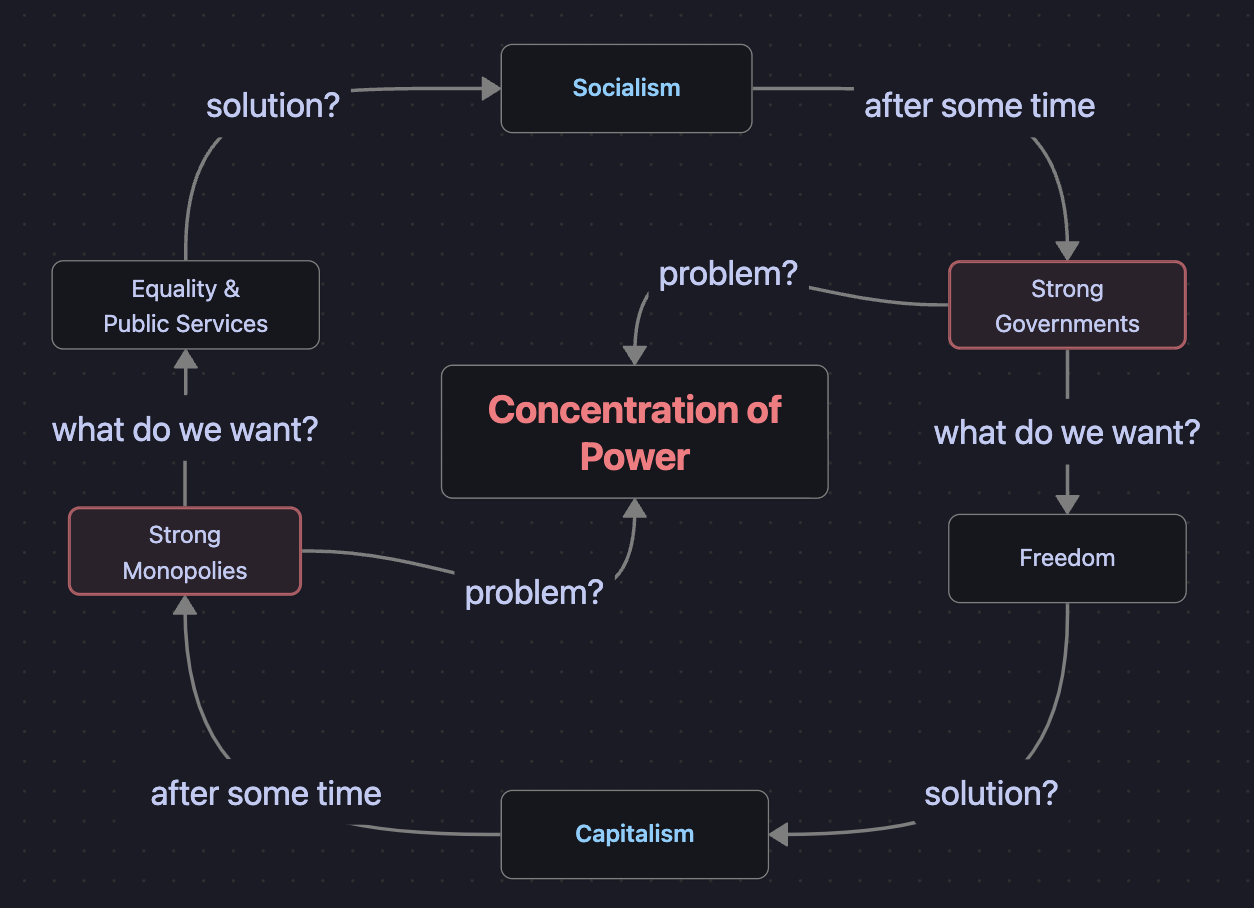
As highlighted in the figure, it’s evidently clear that the two most popular political systems (Capitalism & Socialism) emerged as protests against oppression, in order to eventually introduce a different kind of oppression.
Society seems to be stuck in a vicious cycle of inventing a greater “good” power to govern existing “evil” powers, only for that power itself to become corrupt and present an even greater problem than before.
In order to break this vicious cycle of power, we must look at the common culprit — concentration of power — and find a way to avoid the process by which it occurs.
“You have only one choice. The Ring must be destroyed"
"The very desire of it corrupts the heart… As long as it is in the world it will have a plot for ever. It must be sent into the Fire.”Elrond, Lord of the Rings
Capitalism: A Free Macro-Economy
Economic systems undergo a game of natural selection of their own.
Feudalism

Before Capitalism, we had Feudalism where the king had the final say in all economic matters. It was a time where the class one was born in never really changed. A non-meritocratic system with broken incentives like this meant that its total economic output as a whole showed its limits once it had to face Capitalism.
Capitalism

Capitalism came and freed up the market. This meant that anyone could now take part in economic planning and start their own company. Class mobility and meritocracy now became a thing.
Without planners, the free market became an anarchy that’s regulated by law and prices.
Sadly, the internal structure of companies (hierarchy) still looked very much like monarchies. This meant that inevitably, once the macrocosm has no more room to grow, it starts to take the shape of the microcosm. Late-stage capitalism now resembles Feudalism:
- the anarchic free market regresses back to a stagnating hierarchy of oligarchs.
- the free market becomes clogged with monopolies.
- no meritocracy or class mobility.
Post-Capitalism: A Free Micro-Economy

What if we take the principles of the free market and apply them to the workplace? If we figure out a way to coordinate effectively without forming an elite class:
- coordination at work would no longer breed character traits that are apathetic to the human condition. This would make companies much less greedy.
- companies would become more meritocratic, and therefore more creative & efficient (free market vs planned economy).
- we’d no longer need an authoritarian government.
- the classism & inequality that came from work hierarchies would no longer seep into society.
This’d effectively invent a new kind of socialism that’s bottom-up and doesn’t require an authoritarian government.
Band Aid: Strong Government
A strong authoritarian government may be able to tame the free market towards the benefit of society. This is what China has been doing, and even though it’s been successful, it’s a very risky step down the vicious cycle. What, if anything, ensures that the government doesn’t corrupt? After all, absolute power absolutely corrupts.
Who can we trust?
“Quis custodiet ipsos custodes?”
Latin for “who watches the watchmen?”
No human can be trusted to avoid the corruptible nature of power. This is because human beings are fallible subjective creatures, that at the end of the day, often prioritize their own survival at the expense of equal human beings.
This problem becomes much greater when humans take charge of systems. A system must serve all participants in it, first and foremost. If it stops to do so, it must quickly adapt to one that does. A system is never more important than its participants, and humans must prioritize other humans over failing systems.
If we can’t trust any human to govern impartially, what are we left with? If we let our imagination run wild, an entity that enables our coordination must have the following traits:
- treats all humans equally.
- considers every opinion equally.
- incentivizes “good” behavior (things that are appreciated by the public).
- disincentivizes “bad” behavior (things that are not appreciated by the public).
- has no opinion or will to survive of its own.
The only entity that could have these traits must be of a mathematical nature as only maths is truly objective and unbiased.

It turns out that we have already invented mathematical rules that can run automatically, in the form of software.
Appendix B. Game Theory
Hierarchies

There are two main problems with hierarchies:
- Biased Rules (unbalanced)
The rules of the game are not set by the players themselves, but from the privileged perspective of the people with the most power (the winner). This ensures their inevitable bias against the rest of the participants, effectively enabling the emergence of all forms of unfairness, classism and corruption.
- Bottlenecked Creativity
Since every rank has absolute power over lower ranks, only the creative intelligence of the winners is truly tapped into. The rest of the players are confined by the need to conform. This limits the performance of the system as a whole and leads to its stagnation.
Regulated Anarchy
A preferred system is one that looks more like the above where:
- the rules of the game are determined democratically by the players. This is to ensure that they cover all human perspectives.
- players are allowed some inequality (subject to the rules), but never absolute power and control over each other.
- if built in software, the rules are executed automatically, removing a need for special powerful roles.
Historical Precedent: The Free Market
One must realize that Capitalism proved its superiority over both Feudalism and The Soviet Union for the same reason: anarchy.
Economists call that anarchy the “Free Market”. Many of them worship it. This is because it’s extremely complex and disorganized. It’s also virtually impossible to properly decipher and predict accurately because it doesn’t represent the intentions of an individual… but rather the coordination of millions of companies and individuals towards common incentives.
By tapping into the wisdom of the crowd, this “organized chaos” proved to be much more powerful than hierarchical systems, which were badly bottlenecked in comparison:
- economic decisions were made from limited biased perspectives.
- the planning overhead was often too much to handle.